


 SIP TRUNKING
SIP trunking for AI voice agents
Vobiz SIP trunking connects your AI voice agent, PBX or contact center to the phone network over standard SIP. Bring your own carrier, use ours, or run both.
Works with Vapi, Retell AI, LiveKit, ElevenLabs, OpenAI Realtime and 3CX.
Talk to an engineer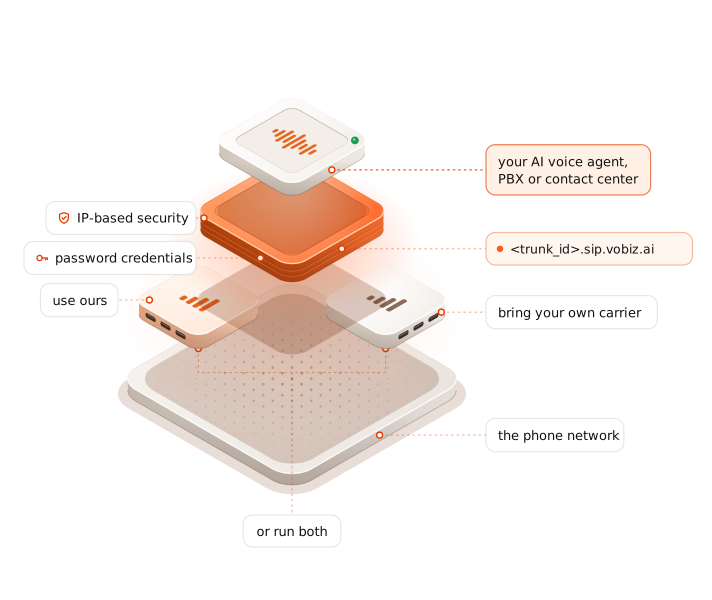


 IP-based security
 password credentials


10min
to first call

Sub-80ms
one-way latency

43
fields on every call record


15M+
calls a day
 How it works
From API key to a live SIP trunk in four calls
No ticket, no provisioning window. Everything below is available in the console or over the REST API.
 API key1234Live SIP trunk
1# Create a trunk: returns trunk_id and its SIP domain2curl -X POST https://api.vobiz.ai/api/v1/Account/$AUTH_ID/trunks \3-H "X-Auth-ID: $AUTH_ID" \4-H "X-Auth-Token: $AUTH_TOKEN"5678
 Built for voice AI
Single-hop media relay over SIP trunk for natural turn-taking latency
A conversational turn has roughly 500ms end to end before a pause feels unnatural, and it has to cover speech-to-text, the model, text-to-speech and the network.
On Vobiz, media crosses exactly one internal relay.
 Carrier / BYOCPSTN · SIP
 Media Engine1 HOPYour agentSTT · LLM · TTS
- One-way latency
- Sub-80ms
- Speech onset
- 50ms
- Signal-to-noise
- 38.4dB

Routing and failover
Configurable SIP trunk failover
On the Vobiz network, calls fall back across multiple carriers automatically, per leg, while the call is being set up.
 If priority 1 fails
Lower priority is tried first; if it fails, the next one takes the call. URIs at the same priority split traffic by weight, so a URI at 20 carries twice the calls of one at 10.

Calls-per-second limits — flood protection on new call attempts, set per trunk.
Disable without deleting — take a trunk out of service and keep its credentials, allowlist and routes intact.
 credentials
Security and access control
Role and IP-based access controls for human and AI agents


Digest credentials
— username and password auth for AI agents, softphones and anything behind NAT. Passwords are write-only and never returned by the API.

IP and CIDR allowlists
— accept traffic only from your SBC, PBX or carrier ranges.


Both at once
— require an allowlisted IP and valid credentials for defense in depth.
 allowlisted IP
 valid credentials
Tenant isolation
— sub-accounts with separate credentials, billing and number pools, so one customer’s trunks never touch another’s.
 billingnumber pool
 billingnumber pool
 billingnumber pool
Integrations
A SIP trunk for Vapi, Retell AI, LiveKit and every platform you run
Connect over standard SIP. Nothing on the platform side changes. Keep the orchestration you chose and bring the carrier underneath it.
See all integrations
 SIP trunk, inbound and outbound



 SIP trunk


 WebSocket audio streams, not SIP
US compliance and number reputation
Outbound calls that get answered, not labelled spam
Vobiz runs number health as an operated service: CNAM registration and spam label monitoring on managed numbers.
Call detail records

Observability
Know whether a bad call was the trunk, the carrier or the model
Every call detail record carries 43 fields — MOS, jitter, packet loss, negotiated codec, which side hung up and why. Fetch by call_id, filter per sub-account, or export to CSV. Trunk webhooks report each call’s start and hangup, including billed seconds and MOS.
- CallInitiated
- Negotiated codec
- MOSJitterPacket loss
- Which side hung upWhy they hung up
- Hangup"Billsec"3"MOS"4.5
Call detail record43 fields{ "data": { "mos": 4.5, "jitter": 0, "packet_loss": 0, "codec": "PCMU", "hangup_source": "Caller", "hangup_cause": "NORMAL_CLEARING", … }}call_id▽ Filter per sub-account↓ Export to CSVRelated
Get started
Your first SIP trunk
in ten minutes
Create a trunk, point your agent at it, place a call.
No ticket, no sales call, no commitment.


FAQ
SIP trunking questions
- A SIP trunk carries voice calls between your own software and the public phone network over the internet, in place of physical phone lines. You point your platform at a SIP address and calls flow both ways.
- A trunk you create yourself in the console or over the REST API. Every trunk gets its own SIP domain the moment it exists, authenticates by digest credentials or an IP allowlist, and routes to any Vobiz number.
- Yes. Point origination URIs at your own carrier or SBC and keep your existing rates, or use Vobiz numbers, or run both side by side on the same trunk.
- Over standard SIP — nothing on the platform side changes. Each platform has its own setup guide; the integrations table above links to them.
- Digest credentials suit AI agents and anything on a dynamic IP. An IP or CIDR allowlist suits a static SBC or PBX. You can require both at once, so a call needs an allowlisted IP and valid credentials.
- Each origination URI carries a priority. The lowest priority is tried first, and if it fails the next is tried in turn, so a carrier going down moves traffic rather than dropping it.
- Priority decides the order URIs are tried. Weight splits traffic between URIs that share a priority — two at the same priority with weights 70 and 30 take that share of calls.
- You set a maximum when you create the trunk and can change it later. Calls-per-second limits sit alongside it as flood protection on new call attempts.
- No. Vobiz numbers are available in 130+ countries and route to a trunk directly, though you can keep your own carrier's numbers if you would rather.
- Managed numbers are monitored for spam labelling and carry CNAM registration, which cuts the spam flag rate by around 30%. On BYOC routes, number reputation stays with your own carrier.
- Every call detail record carries 43 fields — MOS, jitter, packet loss, negotiated codec, which side hung up and why — so you can see whether the audio or the agent was at fault.
- Yes. 3CX and other PBXs connect over a standard SIP trunk with no change to how the PBX is configured.