


Importance of Spam-Risk Detection for Your Numbers
Two ways a business number gets marked spam, why volume and pacing matter more than who's calling, and how to release or fix a flagged number.
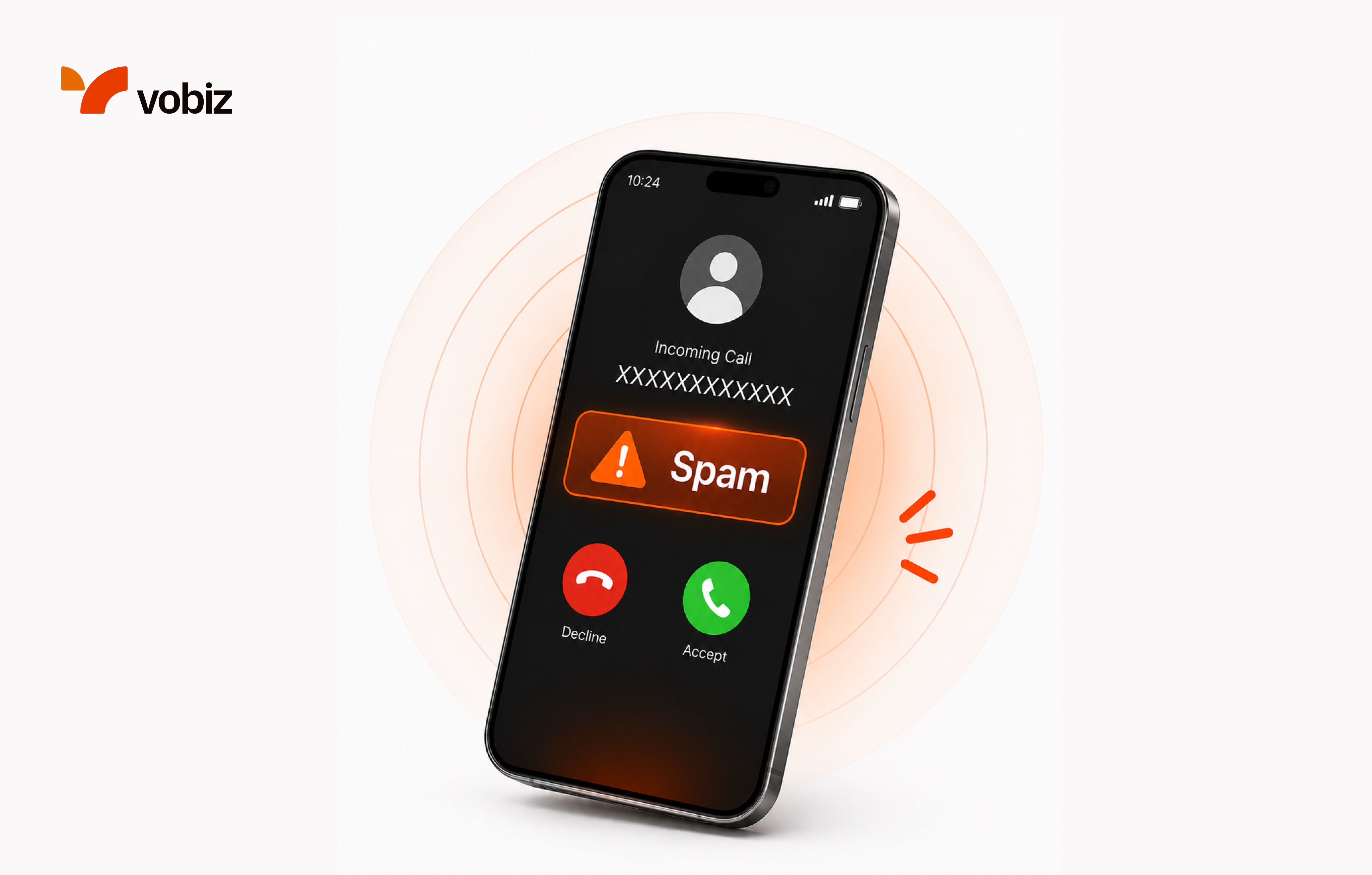
Importance of Spam-Risk Detection for Your Numbers
Every phone number builds a reputation the same way a person does: through repetition. Call the same three friends every week for a year and they pick up without thinking. Call two thousand strangers in an afternoon and, whether or not a single one of them ever complains, the carrier's own systems have already decided what kind of caller you are. Long before a recipient taps "Report Spam," an algorithm has usually made up its mind.
That's the uncomfortable part about number reputation: it isn't really about who's calling. It's about volume, pace, and pattern. A number can carry a completely legitimate campaign and still get quietly throttled or labeled, because the way it is dialed looks more like a machine than a person.
Most teams find out the hard way. Answer rates start slipping, someone on the team notices a number "just isn't performing," and by the time anyone traces it back to the number itself, the damage has been accruing for days. Catching it early, before a carrier decides for you, comes down to watching the right signals.
How to catch a flagged number before it costs you
Checking a number's spam and caller-ID status regularly — daily, not just when something feels off — is the difference between catching a problem early and finding out from a customer. A number can look fine on a campaign dashboard for days after it's already been flagged elsewhere, because campaign-level metrics lag behind carrier and caller-ID decisions.
When a number comes back flagged, there are two honest paths forward: release it and rotate in a fresh one, or fix the underlying pattern and keep using it.
Per-DID analytics tell you how a number is doing when you go look. Catching a flag early means not waiting until you go look.
Why numbers end up flagged in the first place
There are exactly two ways a number gets marked as spam, and they work very differently. One is a human recipient tapping "report" because the call was unwanted. The other, and the one that does far more damage, is a carrier's own detection system watching how a number dials — no human complaint required. A number that goes from zero to thousands of calls with no warm-up, no history, and no rest between calls gives itself away instantly. It doesn't look like a business. It looks like a machine, and carrier systems are built specifically to catch that.
This is why the fix isn't "call less." Plenty of numbers handle high daily volume for months without issue. What separates a healthy high-volume number from a flagged one is whether it built up to that volume gradually, spread it evenly across the day, avoided re-dialing the same contacts over and over, and mixed in some inbound traffic so it reads as a two-way line rather than a one-way blaster. We cover the full mechanics of this in our number health guide and in how a campaign manager handles rotation, daily caps, and cooldown to keep pace looking human by default.
Release, or fix — the two honest options
When a number gets flagged, there's no single right answer, which is why it helps to think through both before you're staring at a flagged number.
Release it. Some numbers have already taken enough damage that recovery costs more time than it's worth. Releasing the number and rotating in a fresh DID from the pool is often the faster route back to a healthy answer rate, especially mid-campaign.
Fix it. Other times the number itself is fine and the pattern around it needs adjusting — the daily cap is too high, the cooldown between calls is too short, or the same contacts are being re-dialed far more than they should be. In that case, the number can usually recover with a short cooling-off period followed by lower, better-paced volume.
Either way, the goal is the same: catch it before a customer tells you your calls stopped connecting.
Built for every market, not just one
Spam-labeling mechanics differ by country. In the US, carrier-side analytics engines and CNAM registration determine what shows up on a recipient's screen. In India, TRAI's carrier-level CNAP standard works alongside separate caller-ID databases that operate independently of the carrier. None of this is region-specific — the same discipline applies wherever you're calling from.
FAQs
How can you tell if a number is at risk of being marked spam?
Checking a number's spam and caller-ID status against the databases carriers and lookup services maintain, on a regular cadence, is the most reliable early warning. Answer rate alone lags behind the actual flag by days.
What should you do when a number gets flagged?
You have two options: release the number and bring in a fresh one from your pool, or fix the underlying calling pattern — lower daily volume, longer cooldown between calls, less repeat-dialing — and let the number cool off before reintroducing it at a lower pace.
Is spam-flagging specific to one caller-ID database or country?
No. Spam and caller-ID status get checked across the databases that carriers and recipients rely on everywhere, not a single region's service.
Curious what your own number pool looks like right now? Number Health is live for every account today.
More Related Articles

CRM Telephony Integrations: Click-to-Call, Call Logging and Global Numbers on Vobiz
Run calling in Salesforce, HubSpot, Zendesk, Pipedrive and more on Vobiz numbers in 130+ countries. See each integration and how it works.
Read full article Team Vobiz
The Telephony Layer for AI Voice Agents: Connecting Vapi, Retell, ElevenLabs, LiveKit, Pipecat & More to Phone Numbers
How AI voice agents connect to phone numbers. SIP trunking, WebSocket streaming and BYOC setup paths for Vapi, Retell AI, ElevenLabs, LiveKit and Pipecat.
Read full article Piyush Sahoo
Mechanisms to Improve RTP Jitter
Learn how carrier-grade voice platforms manage RTP jitter with adaptive buffering, packet loss concealment, FEC, and smart routing for smooth Voice AI calls.
Read full article Vikash Srivastava