When Does Voice AI Need a Phone Number? A Web SDK and WebRTC Primer
Whether or not your voice AI product needs a phone number depends on one thing: does the interaction have to outlive a single browser session. Here's how WebRTC, SIP, and Web SDKs fit together.
When Does Voice AI Need a Phone Number? A Web SDK and WebRTC Primer
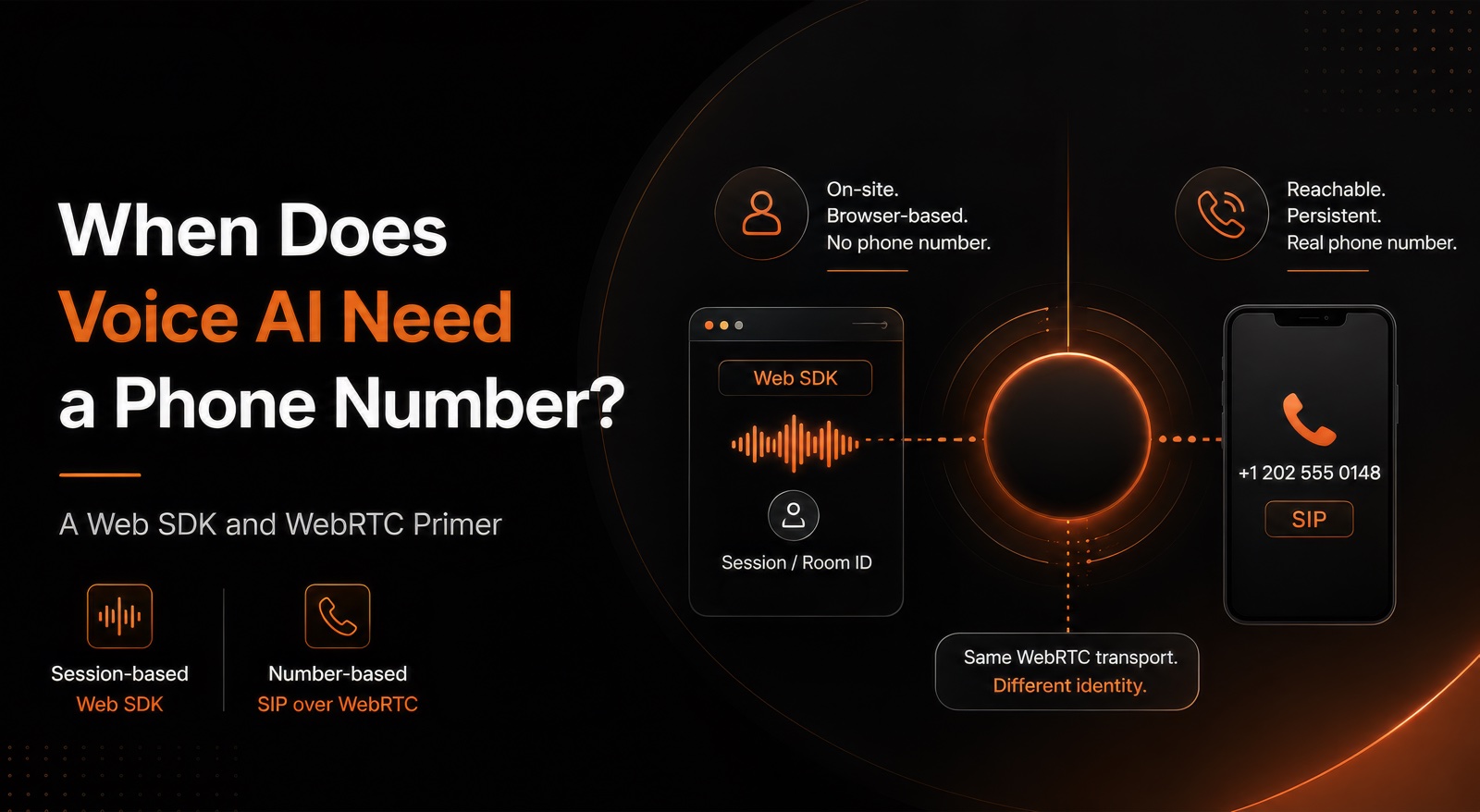
WebRTC — the open browser standard for real-time audio and video — is used in two different ways across voice AI products: with a phone number attached, and without one. This distinction shapes how the system is built, what journey the user goes through, and what the product is used for. This post walks through what each term means, how the two approaches differ in design, and which use cases each one is suited for.
The Terms
WebRTC is a transport layer, not a product. It's the standard that lets a browser stream audio and video in real time without a plugin — the same technology behind Google Meet and Zoom. On its own, it doesn't involve phone numbers, carriers, or identity; it moves audio between two endpoints.
- Spec: w3.org/TR/webrtc
- Overview: webrtc.org
- Developer reference: MDN WebRTC API
A Web SDK is a developer toolkit built on top of WebRTC, typically embedded on a web page or inside an app to offer a "talk to our AI" experience. Identity here is a session or room ID that exists for as long as the browser tab or app session is open — there's no phone number involved.
SIP (Session Initiation Protocol) is the signaling protocol that sets up, manages, and ends phone calls, whether on a hardware handset or a browser tab. A SIP endpoint registers against a real, callable phone number — a DID (direct inward dialing number).
SIP over WebRTC describes a browser registering as a SIP endpoint tied to a real DID. It uses the same WebRTC transport as a Web SDK, but the identity is a persistent phone number rather than a session ID — functionally, a phone delivered through a browser tab.
Communication Design
Session-based (Web SDK). The browser connects to an AI backend through a signaling server, using WebRTC to stream audio. There's no SIP registration and no DID involved. The identity of the conversation is a session or room ID generated for that interaction, and it ends when the tab or session closes.
Number-based (SIP over WebRTC). The browser registers as a SIP endpoint against a real DID, using the same SIP handshake (INVITE / 200 OK) a hardware phone would use, allowing it to send and receive calls to and from the phone network. The identity is the phone number itself, which persists independent of any single session — it can be reached from a hardware phone, a different browser, or an app at a later time.
User Journey
Session-based (Web SDK): a visitor arrives on a page, clicks to start a conversation, grants mic access in that tab, and has the interaction inline. The session ends when they navigate away or close the tab, and there's no way to reach that same person again unless they return to the same page and start a new session.
Number-based (SIP over WebRTC): a user — a support agent, a driver, an authenticated app user — opens a web app tied to a real number they're reachable at. They can place or receive calls the way they would on an ordinary phone, including to and from the regular phone network (PSTN), and the number remains reachable across sessions, devices, and time.
Use Cases
Session-based / Web SDK:
- Landing-page demos or sales-page voice agents
- Embedded on-site support widgets
- Internal tools where interactions start inside the app
Number-based / SIP over WebRTC:
- Browser-based contact center agents, without hardware phones
- In-app calling that bridges to real numbers — for example, a delivery driver calling a customer from an app
- Interactions that need outbound calling, such as reminders or follow-ups, placed from a browser
Side by Side
| Session-based (Web SDK) | Number-based (SIP over WebRTC) | |
|---|---|---|
| Transport | WebRTC | WebRTC |
| Signaling | Session/room ID via a signaling server | SIP registration to a real DID |
| Identity | Exists for the open session | A persistent phone number |
| Reachable from a regular phone | No | Yes |
| Outbound calling | No | Yes |
| Typical use | On-site, browser-based interactions | Interactions needing a persistent, callable identity |
Where AI-Native Telephony Sits in This Picture
WebRTC is the shared transport in both approaches described above. What differs is whether a phone number is registered to the session. AI-native telephony infrastructure, like Vobiz, provides the number side of this: a DID that can be registered to a browser over SIP-over-WebRTC, to a hardware SIP phone, or bridged to the regular phone network. Numbers are provisioned in under 10 minutes, span 130+ countries, and run at roughly 80ms latency over SIP trunking.
In practice, the choice between the two approaches comes down to whether the interaction needs a persistent, callable identity or only a session that lasts as long as the tab is open. If it's the former, that's what a registered phone number provides, regardless of whether it ends up in a browser, a hardware phone, or bridged to the regular phone network.
FAQs
What's the difference between a Web SDK and SIP over WebRTC?
A Web SDK is session-based — identity is a room or session ID that exists only while the browser tab is open, with no phone number involved. SIP over WebRTC registers the same WebRTC transport against a real, persistent phone number.
Is WebRTC the same as telephony?
No. WebRTC is a transport layer that can carry a session without a phone number (a Web SDK) or a call registered to a real number (SIP over WebRTC). Whether an interaction counts as telephony depends on whether a real number is involved, not which transport carries the audio.
Can a phone number be used inside a browser?
Yes. A DID can be registered to a browser over SIP-over-WebRTC, so the browser functions as a phone — reachable from, and able to call, the regular phone network.
When does a voice AI product need a Web SDK versus a phone number?
A Web SDK fits when every interaction starts on the product's own site or app. A phone number is needed when the product must be reachable independent of a specific session, or needs to make outbound calls.
More Related Articles

The Telephony Layer Playbook for Voice AI Teams
Most voice AI failures don't start in the model. They start in the telephony layer. Download our 8-page playbook for voice AI teams.
Read full article
Sub-80ms RTT Voice Infrastructure: How Vobiz Delivers Production-Ready Low Latency for AI Agents (2026)
Most voice AI stacks settle for 1500-2500ms. Vobiz targets sub-80ms average RTT on the carrier leg. Here's the exact infrastructure stack that makes it possible - and why it matters at scale.
Read full article Piyush Sahoo
Why India's AI Voice Boom Will Be Won at the Infrastructure Layer, Not the Model Layer
India's AI voice boom is accelerating - but the real competitive moat isn't the LLM. It's carrier interconnects, TRAI compliance, and sub-100ms telephony infrastructure. Here's why.
Read full article Ishani Singh